Keep Going (On Writing and Nature)
I’ve never identified as a writer. I haven’t mastered the English language. I don’t feel confident that I could spot grammatical errors with ease. Though I feel able to build paragraph structure, I don’t feel I can build structure for an entire book, or even sometimes, a blog post. But this is why I am doing this blogging exercise: it’s a great way to practice writing in addition to sharing my passions. I might look back at it in a couple of years and feel a blush of embarrassment across my face as I see the blatant errors; that’s okay. A person doesn’t have to be a professional, trained writer to be a writer, but they do have to write regularly and read. I do both.
I’ve been lucky enough to find a writing group, which I think is also an important part of being a writer - at least at the beginning. Writing in solitude can create an echo chamber; you only have your own ideas and those you read about. You have no one to run your ideas by, to share your writing with, to get feedback from. Without community there is no one to share their writing with you or their creative ideas. Our writing group consists of two people, me and her. Which is perfect. My manuscript is deeply personal, it’s painful and it’s meant to one day be, as it’s named, “What I would have said to her”, my story to share with any young indigenous girl struggling, or anyone who needs to hear it. I’m writing because it’s too late to say it to her, but it’s not too late to share the medicine that saved me. So, having a single person to bounce ideas and writings back and forth with is perfect, safe and perfectly sufficient to facilitate growth.
Today, ‘Write, Am I Right?’ was a virtual session because my partner was ill. It was a short session, but it was a productive one. We do writing prompts at the beginning of each session; the prompts can be anything, from anywhere. Since I was home, I was able to grab one of my Austin Kleon books to select a prompt from. I walked down to my office with no one in mind and grabbed the one that stood out to me, which happened to be “Keep Going”. It stood out to me because I have been struggling with my motivation to keep going on my manuscript, despite my self-imposed deadline, which happens to be coming up fast. I went back upstairs to my laptop and writing group zoom meet, sat down, then opened the book to a random page and was greeted by a great quote for a writing prompt. Now, the idea is to free flow, not to write anything incredible or even structured, but simply to put pen to paper and warm up the ol’ brain and hand. Because yes, we write with pens on paper.
We do two and today was no different. The first one I landed on was “I must decline, for secret reasons” by E.B. White. This made both of us laugh out loud, can you imagine saying that to someone? So good. The idea of this spread in the book is to protect your time, it’s permission to “decline all sorts of invitations from the world”. The following is my free flow.
Sometimes the invitation comes from inside, rather than from the external world. While you must protect your time from the world, you must also protect your time from yourself.
Set a schedule, be intentional, and make a time-bound promise set in metaphorical bricks (blocks) in your calendar. Time blocking. You should lay those bricks down on Sunday. (I heard this on a Mel Robbins podcast on time management)
There are so many things to spend your time on, we spend it because once it’s gone, it’s spent. Time is a resource; it’s precious and limited. We do not get time back.
First, we need to identify what gives us purpose; purpose fuels intentionality. Purpose often comes from what you value, find that and build your structure out of it.This book has been challenging for me; it’s hard work, mentally. But, the sooner it is complete, the sooner I can share it and the sooner it can fulful it’s purpose. The sooner it is complete, the sooner I free up that time, that cognitive load, to instead take action. The time saved from writing, or procrastinating from writing, can be spent on connecting with my local community, volunteering, learning and continuing to share. I squander too much time unintentionally, because I mentally save time for writing, but don’t specifically block it, then often find I’ve gotten off track.
The second prompt we did was from the same book, it was two directly related quotes:
“To pay attention, this is our endless and proper work.” by Mary Oliver
“Tell me to what you pay attention and I will tell you who you are.” by Jose Ortega y Gassett
Here is my second free flow, I’ve added to this one since more came up for me while I was typing it out:
Physical: Fitness, weightlifting, mountain sports, nutrition, my plants.
Mental: Ojibwe culture, language, reading, writing
People: My love, friends, families needs
Nature is missing from this list, aside from my house plants. It can be grouped under culture, but it isn’t enough. I’d set a goal to start a “Land and Language Field Journal” with the intention of starting this when I was in Wabigoon to learn about the local to that region, plants, shrubs and trees. Instead, I’d like for that journal to be inclusive of my new home region, so I’ll start it now. I’ll use Google Lens where needed to identify the plants, luckily I can also leverage my husband's and friends' knowledge, of which they have plenty. Then, when I return home, I’ll take moments to reflect and write the Ojibwe name beside its English name, queuing up research for medicinal properties.
When I received my Ojibwe name, the elder gave me Bear Root and told me to use it in my smudge or when my stomach was particularly off to put a small amount in my mouth, but not swallow. She said I carry my stress in my stomach, which I do. She told me that this was not a medicine from where she was from (close to where I am from, originally) and that it was hard for her to come by but that I needed it more. She also said it was important I learn my local medicines (from the region I now live in). I don’t think this elder knew where I resided, but she happened to give me a medicine from my home mountains. I can’t help but feel this was intentional. It turns out I had been walking by this beautiful medicine ever since I moved to BC and started hiking, both in the Monshees where I first started venturing into the mountains and in all the Kootenay ranges all around my home.
In previous years, my psychologist had told me to walk in nature, to listen to the sounds, smell the scents and feel the weather, to notice the differences in the months. This made me feel a sense of time, like for years to come I will be walking these local paths and recognizing the seasonality of the plants and animals. I now know it is important to pay attention, to pay attention means to learn the names of the relatives I pass.The Bear Root, the Cedar, the Skunk Cabbage and the animals tending to the plants.
Being human is connecting with nature, being modern, it seems, is watching nature on a screen or through a window. I want to be human, I want others to learn to be human again - to engage with nature so we can learn to live in reciprocity with nature. Earth gives us everything we need to survive but we take more than we need, and in turn we pollute instead of mending. Being in nature means more time engaging with the earth with our bodies, and less time consuming, wasting energy and creating harmful pollutants. Being in nature allows us to see, hear and feel what the earth needs, to think consciously about how our actions have an impact, positive or negative. Through paying attention when I am in nature, recognizing the changes in seasons, learning the medicines, I hope to learn reciprocity and to share that knowledge with generations to come.
If you don’t know your purpose, I might suggest writing. As you can see, free form writing (prompted or unprompted) is a great way to navigate the mind. Anyone can write, the act of writing is a way of engaging with your own thoughts and learning about yourself. As we saw in todays prompts, writing can help you identify important things like what you pay attention to or perhaps the challenges you’re having and even a path to navigate around them. It can also help you get outside of your self, and into nature. I recently suggested to my husband to try “braindumps” at the end of his work day - this is a writing exercise where you write down everything you’re thinking of to ease your mental burden from the day (usually of work), the result is a list for the next day and a clean state to move into the rest of your current day. Another great exercise is simply journaling, you don’t need to be a writer to journal, you just need a pen, paper and intentionality, even if all you write to start is “I don’t know what to write on this paper”, you will be suprised at what comes flowing out.
Todays writing exercise brings me joy, it gave me an idea to expand a goal, to engage more with nature, to smudge, to pull out my ‘rite-in-the-rain’, my planner and take action. I put things in motion before even typing out out what I had written today and this all came from some random prompts shared with a lovely friend over a Zoom call. Writing is a gateway to productivity and personal improvement through life long learning. You never know what you’ll find when you take a moment, to be in the moment and explore your mind.
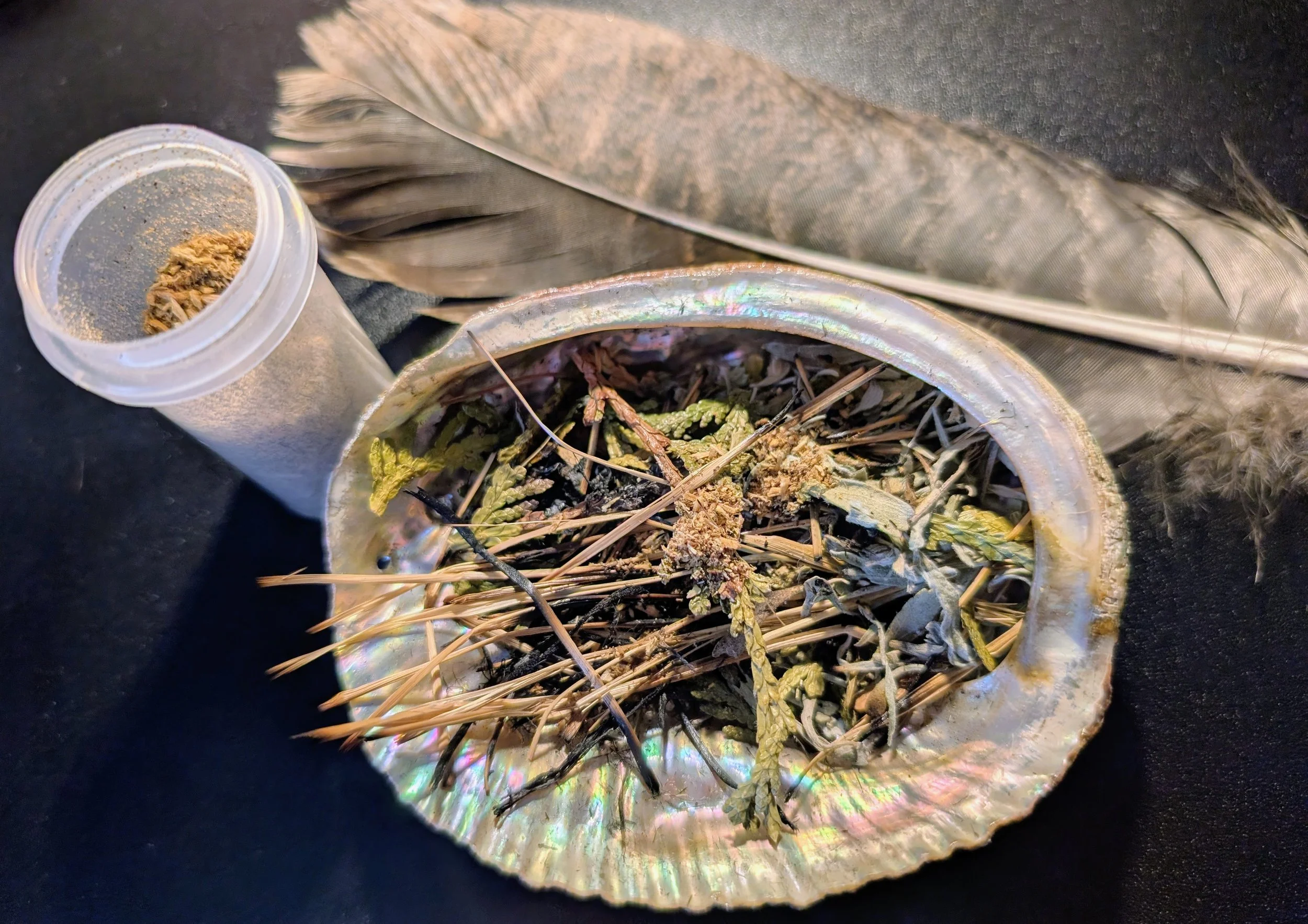
Bear Root (Osha), a feather (often I use turkey because we have so many around here) and a smudge bowl (abalone shell) with cedar, sage, sweetgrass and bear root
